How To Achieving Positive Expectations: 6 Tips

Balance is the secret to a positive life
The Beginning
No matter what you expect out of life, no matter what you strive for might be stopping you from achieving what you want out of yourself and your life accomplishments. No matter what difficulties you might be facing in your life right now or problem circumstances you have been experiencing, everything comes back to the expectations you are living by.
If you want to fulfill expectations you carry and overcome an obstacle, you must start with your knowing what your expectations are through awareness.
How To Guide Yourself in Achieving Healthy Self-expectations
To start to change you need to know what is an expectation.
What is an expectation? For the purpose of addressing this topic, the word expectation will be defined as accomplishments, behaviors, personal beliefs, loyalties, performance (success, or failure) and personal beliefs that are future projections taught or place upon a person by others who he or she have an emotional attachment too. The emotional attachment can be negative or positive causing expectations to accept unhealthy demands, life direction, needs, wants, or wishes.
The emotional attachment can be negative or positive causing expectations to accept unhealthy demands, life direction, needs, wants, or wishes.
Ask yourself
Are the expectations you're carrying today possibly the downfall of what you're striving to attain success or fulfillment, happiness, or satisfaction with yourself and your life? Or are they what is throwing you out of balance? There are multiple elements that
There are multiple elements that affect success or failure in your life. One marker that tells you that you have a barrier or resistance to becoming successful or fulfilled is the extent you focus on a desire or need for external validation through the feeling to complete other's expectations that they have or have set onto you.
External validation is the act of you seeking another person's positive judgment of them to affirm their own view of self. External validation is the precursor to the acceptance of distorted or unhealthy expectations from another person. External validation is other's opinions, perceptions and prejudices taught to you or forced upon you through an emotional attachment Therefore you take them on as your own. What cause causes you to accept other’s validation? It is the emotional acceptance or type of love you want from the other person. The external validation stirs up personal confusion.
Healthy external validation is when you use it for your reference, not as your truth. In order to take in external validation and have it be healthy one has to have a strong and supportive internal validation, to begin with.
An intense desire or need for other’s external validation is a strong indicator you are living by someone else's expectations. When you're externally validating, you overlook and devalued your personal authority, beliefs, expectations, goals, philosophy, and values as well as yourself. If this is occurring then personal trust is lost, disappointment and self-doubt sets in. You question your decisions and judgment of your performance and you become severely critical of yourself. Also, you shift your loyalty away from yourself and believe other people's assessment and judgment of you. Your mindset shifts to a totally negative position toward yourself. You act, feel, thinks and react as dictated by other people's wants, wishes, and projections.
Excepting validations by being driven or desiring to achieve unhealthy expectations which are not your own causes you to travel in a disappointing and unhealthy direction of your life. You feel like you are living a lie and can't trust or live your own expectations and think you are out of control. To be healthy, you have to live by the expectations you create, accept, and work toward fulfilling. When you disavow your own expectations expressed through your needs and wants while attempting to achieve expectations set by another person, authority figures, culture, your family, favorite teacher, sports coaches, or religious figures is a recipe for disappointment and unhappiness. After many years of living by someone else's expectations, those unacceptable expectations become your standard, good or bad. You feel like you are not enough and not living as your true self. Reliance on external validation through doing what others want and non-responsiveness to your core beliefs creates an unhealthy pattern that is very hard to break and you suffer in your growth and performance.
An example is when a son grows up attempting to be what his father wanted him to be, he feels lost and disappointed in himself because he involved himself in sports when it was not his passion and didn't like it. He goes on to law school because his father always wanted him to be a lawyer. He graduated from law school and once in law practice, he finds himself angry, disappointed and unfulfilled. To compensate, he submerges himself in alcohol and never knows why.
Other Peoples Expectations Can Ruin your Life
Look at this Subject Deeper Someone Else's Story
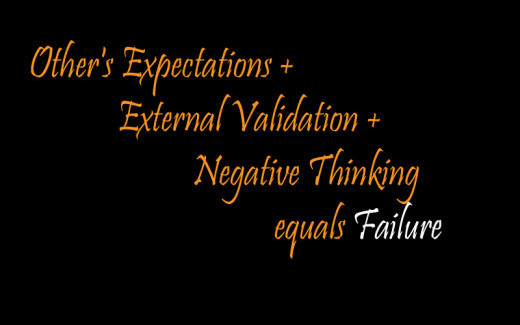
In examining and contemplating on this subject of expectations further, all the elements can be placed into a mathematical formula.
Other's Expectations + External Validation + Negative Thinking = Failure
Pondering the formula closer, you can see that even if a person is able to work hard and change negative thinking and redirect validation internal or self, he or she may still experience failure. Why? With the first question at the being of this article "can expectations be the downfall in healing?", and in the equation, it appears that expectations play a larger major role in one’s life.
A follow-up question would be "are the expectations one lives by theirs or someone else's?" Whether overtly, covertly or assumed, living by someone else’s expectations other than their own appear to hold one-third of the power in the formula. The one-third seems to keep old unsuccessful behavior patterns strong enough to rule out any successful change in the other two components. So the thought "just tell me what you want me to be and I will", is an external validation mindset and negative against self. Therefore based on living by “others expectations” in the formula would continue to exert its control over becoming healthy or succeeding.
Another example of this occurrence was a 38-year-old female who had been in therapy for years to combat PTSD and depression resulting from childhood sexual abuse. She had been committed and dedicated to her therapy, and did everything she was asked. No longer did she live by external validation and had achieved internal validation and self-communication. With hard work and self-support, she re-programmed her negative thinking, yet her triumphs usually ended in a series of failures and self-sabotaging acts. Until one day her therapist asked her to explore the expectations that she lived by. She discovered that the resistance that kept her from succeeding was that she was two expectations she had held onto unknowingly from her parents and was trying to fulfill. The first one from her father was that she would “never amount to nothing” (never being successful). The second expectation that crippled her recovery came from her first husband. During a short abusive marriage, her husband viciously had told her over and over that she was “worthless”. The combination of these two hidden expectations canceled out any success she could mount in her life. Once she replaced recognized all her expectations and corrected them with her own expectations, her recovery took off.
How do I get healthy expectations of my own?
The assignment below will assist you to step by step in assessing, recognizing the origin and then creating new expectations. You can break the hold old unconscious expectations taught or placed upon you by others. Take out a sheet of paper and begin.
6 Tips in Creating Healthy Expectations
Tip one – draw a line down the middle of the paper from top to bottom. On the left side of the paper, write a list of all the expectations that you are living by in your life.
Tip two – study the list. Once completed, on the right side of the line, write down the origin of that expectation (who or where you first felt it). Write who gave you each expectation (examples - abuser, authority figure, cultural figure, family, father, mother, religious leader, self, sibling, teacher, etc.).
Tip three – study both columns. Evaluate each expectation and its origin. Determine whether each one is acceptable to you today and do you want to continue to live by it.
Tip four – take out a new piece of paper. Now create a new list of expectations from scratch. Make sure you have space between each expectation. Transfer over any expectation you want to keep from the first list and alter it if need be. This time make sure you write next to each expectation how you will measure progress and successful completion of each. Then under each expectation assign a timeline for completion. Be sure that each expectation is reasonable and that you are willing to own as yours.
Tip five – study your new expectation list. Draw a circle around three that you can effect change on right away. Study the three you have picked and then rank them 1, 2 and 3. Start with number one and begin working on it right away. (If you try to work on all of them at once and divide your time between them, you will surely be overwhelmed, see no progress, become disappointed, self-sabotage and give up on all. So focus on completing one at a time to assure success)
Tipssix – is the action step. Pledge your commitment to each one. Be consistency. Work hard, one expectation at a time. Once you have completed the first three, go back to the list and pick three more and begin again.

Take away
Living by your own set of self-expectations can open you to move in a new direction. So do not wait any longer, remove unproductive or unattainable expectations, create and establish new expectations, therefore manifesting your personal authority as well as live by new attainable expectations you created especially for yourself.
© 2010 Bill Tollefson